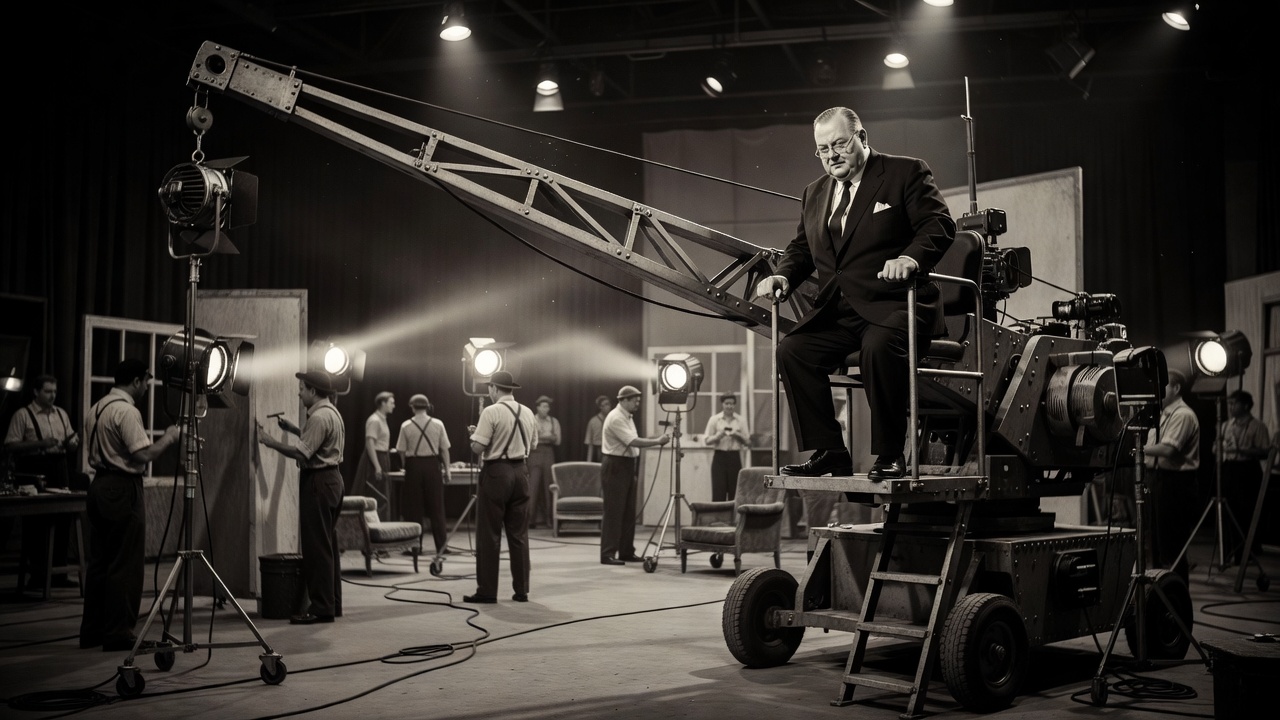
True cinephiles recognize an auteur not just by their name in the credits, but by their recurring framing geometry, dolly zoom speeds, and sound dampening preferences.
Alfred Hitchcock: The Architecture of Suspense
Storyboards, camera dollies, and the invention of the "Vertigo effect".
Hitchcock famously asserted that the film was completely finished in his mind once the storyboard illustrations were completed; the actual filming on the studio floor was merely a mechanical necessity.
During the production of Vertigo (1958), camera operator Irmin Roberts solved Hitchcock's request to visualize Scottie Ferguson's acrophobia by simultaneously zooming the lens forward while dollying the entire camera rig backward—creating an unsettling spatial distortion where perspective lines stretch while the central subject remains fixed in the frame.
In which of Hitchcock's films did he make his cameo appearance by showing up in a newspaper weight-loss advertisement, because the entire narrative took place inside a single confined lifeboat?
Akira Kurosawa: Weather & Axial Cutting
Multiple telephoto setups, ink-dyed rain, and wipes.
Akira Kurosawa transformed editing rhythms with his signature axial cut—suddenly cutting along the exact same camera axis closer to or further from an actor, without altering the lens angle. He also pioneered using three telephoto cameras simultaneously at different angles during battle scenes in Seven Samurai (1954) so the actors never knew which lens was framing them.
In Rashomon (1950), what practical trick did cinematographer Kazuo Miyagawa use to ensure that the heavy torrential rain falling outside the temple gate would show up vividly on high-contrast black-and-white film?